
Will a marketing hire create more work than it solves?
 Katie LendelFounder & Strategic Marketing Lead
Many of the owners I talk to are partway through a job description for a marketing hire. It started as one line. By the time they show it to me, it covers strategy, content, social, search, email, campaigns, analytics, the website and the CRM.
I run a marketing partnership, so I have an obvious reason to say a hire is the wrong move. I don't think it always is. Sometimes an in-house hire is exactly right, and I'll say when. Here is how a hire can end up costing the owner more time than the work it was meant to take off.
After 17 years in marketing, the question underneath the job description is the same one I hear in different words: who is going to own this?
How a job description turns into a department
Most marketing job descriptions get written by adding up everything that isn't getting done. Each line is reasonable on its own. This is the list I see again and again:
- Strategy
- Content
- Social
- Search
- Campaigns
- Analytics
- Website
- CRM
Together, those nine lines describe a department, not a person. Strategy, writing, search, email and technical work are different crafts, and they rarely live in one head.
One person can't carry all of it. The hire chooses what to drop, and freelancers quietly cover the rest. Before long, the business is managing a person and the specialists behind that person. The role that was supposed to lift marketing off the owner has become another set of relationships to run.
Sorting the lines into three piles
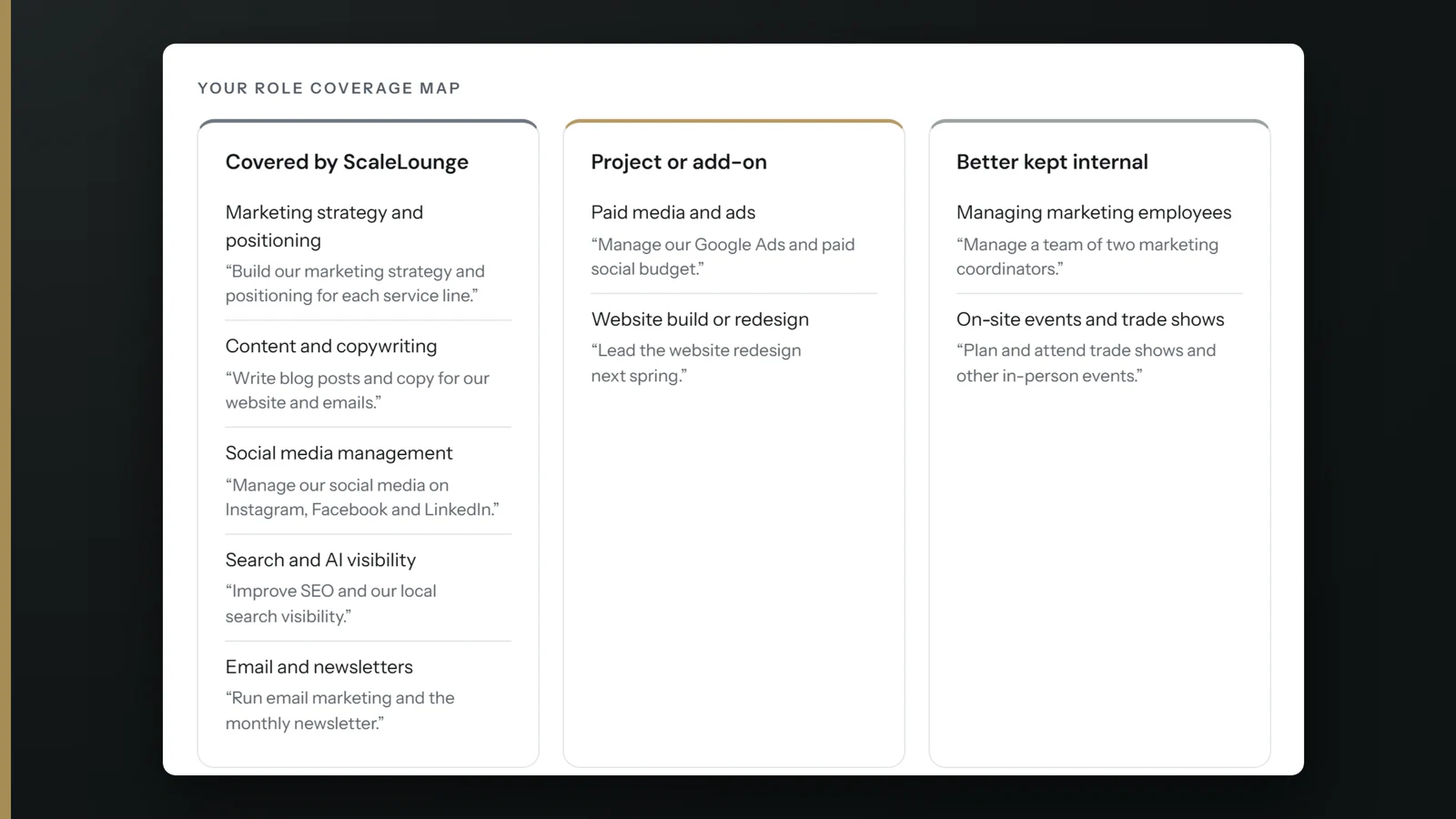
When I read a job description, I sort each line into one of three piles:
- Work a partner can own every month, such as strategy, content, search and email.
- Work that is a real project, scoped and priced on its own, such as a website build.
- Work that belongs with an employee, such as managing people or being in the room every day.
The role coverage map on the Before you hire page sorts a pasted description the same way, with fixed rules instead of guesswork. It quotes the line behind every match and leaves out anything it doesn't recognize rather than claiming it. If someone asks me to review a description, I read the whole thing myself and say plainly whether it is a hire or an engagement.
ScaleLounge takes this work off an owner's plate, from the strategy to the work itself. See how ScaleLounge works.
What a hire involves before the first post goes out
Recruiting comes first. Then a notice period. Then onboarding, the stretch where a new person learns your customers, your offer and the way you talk about both. The marketing itself starts moving after all of that.
The cost has a shape that's easy to underestimate: salary plus employment overhead, plus whatever the gaps cost. The gaps are the freelancers I mentioned. I won't put a salary number here, since it depends on the city and the person, but the line for the hire is rarely the whole budget.
The managing sits with the owner too. You set the direction, you manage the person, and you cover what they can't. That's a fair arrangement when the person is a senior leader you chose to build around. It's a heavier one when the hire was meant to take work off your plate.
When an in-house hire is the better answer
Some roles belong inside the company, and I tell owners so. These are the ones I'd point to:
- The role carries substantial internal leadership.
- It includes managing employees.
- It involves on-site events or a physical presence.
- It needs daily cross-functional meetings, where being in the building matters.
If that's the role, a partner can't do it, and I'd rather say so than take the engagement.
Two other cases come up. When the work needs deep specialist capacity or a larger production team every month, a specialist agency can be the right choice. Paid media at real scale is a good reason to bring in an agency, and so is having an internal lead who can direct one.
When a business already has a marketing manager, ScaleLounge becomes the execution capacity behind them.
How a partner is shaped differently
Here is how the two compare in the places owners tell me matter most:
- Getting started. A hire means recruiting, a notice period and onboarding. On every plan with ScaleLounge, the strategy arrives within 24 to 48 hours of the completed intake.
- Who manages it. With a hire, you manage the role. With ScaleLounge there is one relationship, with me. I own the strategy and I'm your point of contact.
- Capability. One person brings one skill set, and freelancers fill the gaps. ScaleLounge covers strategy, content, search, email and campaigns across its plans. Web builds are quoted as projects.
- Cost shape. Salary and overhead plus the gaps on one side. A fixed monthly engagement on the other, with specialist projects quoted separately.
- What the owner does. Sets priorities, gives context and approves the work. Every piece comes to you first in one private workspace, and nothing is published before your yes. Approving works from a laptop or a phone.
A partner isn't always cheaper than a junior hire. It's a different shape: no recruiting, no ramp, and one place to see what's happening.
What the plans cost
Price is usually the first thing owners wonder about, so here it is plainly:
- Social Essentials, $650 a month. Month to month. A strategy for your social, 8 original posts a month adapted across up to 3 social accounts, and 1 YouTube video a month, each published after your approval.
- Growth Partner, $2,500 a month. A full marketing strategy across every channel. Typically 12 posts, 2 short-form videos, 4 YouTube videos and 4 SEO articles a month.
- Scale Partner, $5,500 a month. Growth plus campaigns, email and conversion work. Typically 20 posts, 3 short-form videos, 8 YouTube videos, 8 SEO articles and 4 newsletters a month.
- Executive Partner. By application, for marketing leadership across several businesses, with an agreed scope.
Growth Partner and Scale Partner begin with a 90-day initial partnership, then run month to month. Brand Presence Setup is $1,200 one time, covering your brand kit and up to 8 profiles plus Google Business where your business is eligible, and it's included with the Growth, Scale and Executive plans.
Some limits, stated up front. ScaleLounge isn't a sales team, doesn't manage your employees and doesn't run on-site events. Paid media, website builds and complex funnel work are scoped as projects instead of bundled into a monthly plan. And no revenue number is guaranteed, in writing or in conversation. What I offer is the approach and the accountability for it.
The question I ask before anything else
The question isn't only who does the tasks. It's who connects the plan, makes the decisions and keeps the work moving. So I ask owners what they need owned, and the answers tend to fall into three groups:
- A defined deliverable. A strategy for social, plus consistent content created and published. That usually fits Social Essentials.
- Direction and execution. A partner who connects the priorities, the production and the day-to-day follow-through. That usually fits Growth Partner or Scale Partner.
- An internal leadership role. On-site presence, employee management or deep internal responsibilities. That usually fits an in-house hire.
What owners describe to me is rarely another employee. It's someone to finally own marketing. When that's the need, the owner's part comes down to the priorities, the context and the yes. When it isn't, I'll say that too.
Rather hand this off than add it to your week? That is what ScaleLounge is for. See what ScaleLounge handles.
FAQ
Can a marketing partner replace a marketing manager hire?
Often, when the role is mainly digital marketing strategy and execution. If it needs substantial internal leadership, employee management, events or on-site work, an in-house hire may still make more sense.
What if we already have a marketing manager?
Then ScaleLounge becomes the execution capacity behind them. Your marketing lead keeps ownership internally and gains specialist capacity without several more hires.
How does the cost of a marketing partner compare with a hire?
It's a different shape, not always a cheaper one. A hire is salary plus employment overhead, plus whatever the gaps cost. A partner is a fixed monthly engagement: $650 for Social Essentials, $2,500 for Growth Partner or $5,500 for Scale Partner, with specialist projects quoted separately. What changes is that there's no recruiting and no ramp.
