
What AI answers draw on when they describe your business
 Katie LendelFounder & Strategic Marketing Lead
More people now start their research by asking an AI tool a question. Who handles bookkeeping for a practice like mine? What does this company actually do? Is this the right kind of firm for a business my size?
The question that follows is whether the AI will name a particular business. I can't answer that, and I'm wary of anyone who says they can. What I can describe is what those answers draw on, because that part is knowable.
This is that description. It turns out to be mostly ordinary marketing work, which I find oddly reassuring.
AI answers summarize what the web says
When someone asks an AI tool about a business, the answer isn't pulled from a private file. It draws on what is already written about that business on the web. Some tools search the web as they answer and show the sources they used.
The raw material is usually some mix of these:
- The business's own website, page by page
- Its profiles and listings on other sites
- The articles and posts it has published
- What other sites say about it
An answer can only describe what it can find. When that material is clear and agrees with itself, there's more to work with. When it's thin, scattered or contradictory, there's less.
That's the whole mechanism, as far as I can honestly describe it. Everything below is about the material.
ScaleLounge takes this work off an owner's plate, from the strategy to the work itself. See how ScaleLounge works.
Three things answers have to work with
Clear positioning
The first thing I look for on any business's site is a plain statement of who it serves and what it does. Not a tagline. A sentence a stranger could repeat back.
Picture a bookkeeping firm that works with dental practices. It's an invented example, not a client. If its homepage says exactly that in one sentence, there's a clear business to summarize. In a vaguer version, the homepage says "financial solutions for growing companies." That could describe thousands of firms, and an answer built from it ends up just as general.
I see the vague version more often than the plain one. It's rarely careless. It usually comes from years of small edits made at different times for different reasons, until the original sentence got sanded down to nothing.
A plain sentence helps people too. A new customer reading the homepage learns the same thing the answer does, and learns it faster.
Consistent details
Then comes the plain stuff. The business name written one way. The same services described the same way. The same city or service area. The same website address.
These details are boring, which is exactly why they matter. They're the facts an answer repeats. When two sources disagree about what a business is called or whether it offers a service, an answer has less to go on. It may pick one or hedge, and neither does the business any favors.
It's the least glamorous part of the work, and the part that quietly holds up the rest.
Useful articles
Buyers ask real questions before they buy. The ones I'd expect to see:
- How long does it take?
- What happens in the first appointment, or the first week?
- How is this different from the other way of doing it?
- Who is this a good fit for, and who is it not?
A business that answers those in its own words, with specifics, has put something on the web that an answer can use and that a person can read.
Specifics are what I keep coming back to. A page that says "we deliver quality service" gives an answer nothing to repeat. A page that explains what happens in that first appointment, or what a typical timeline looks like, gives it something concrete.
I write these for the person reading first. If an article genuinely answers their question, it has done most of its job, whoever else ends up reading it.
What nobody can honestly promise
Here's the part I'd rather say plainly. Nobody controls what an AI tool says about a business. Answers can differ from one tool to the next and from one session to the next, and what a person sees can depend on their account and history. The same question can come back with a different list of names.
So I don't promise that clear positioning, consistent details and useful articles will get a business named. They give an answer more to work with. That's the claim, and it's as far as I'll go.
I run a marketing company, so I have an obvious reason to make this sound bigger than it is. It isn't bigger. It's a foundation, and I'd call it nothing more.
How the measuring stays honest
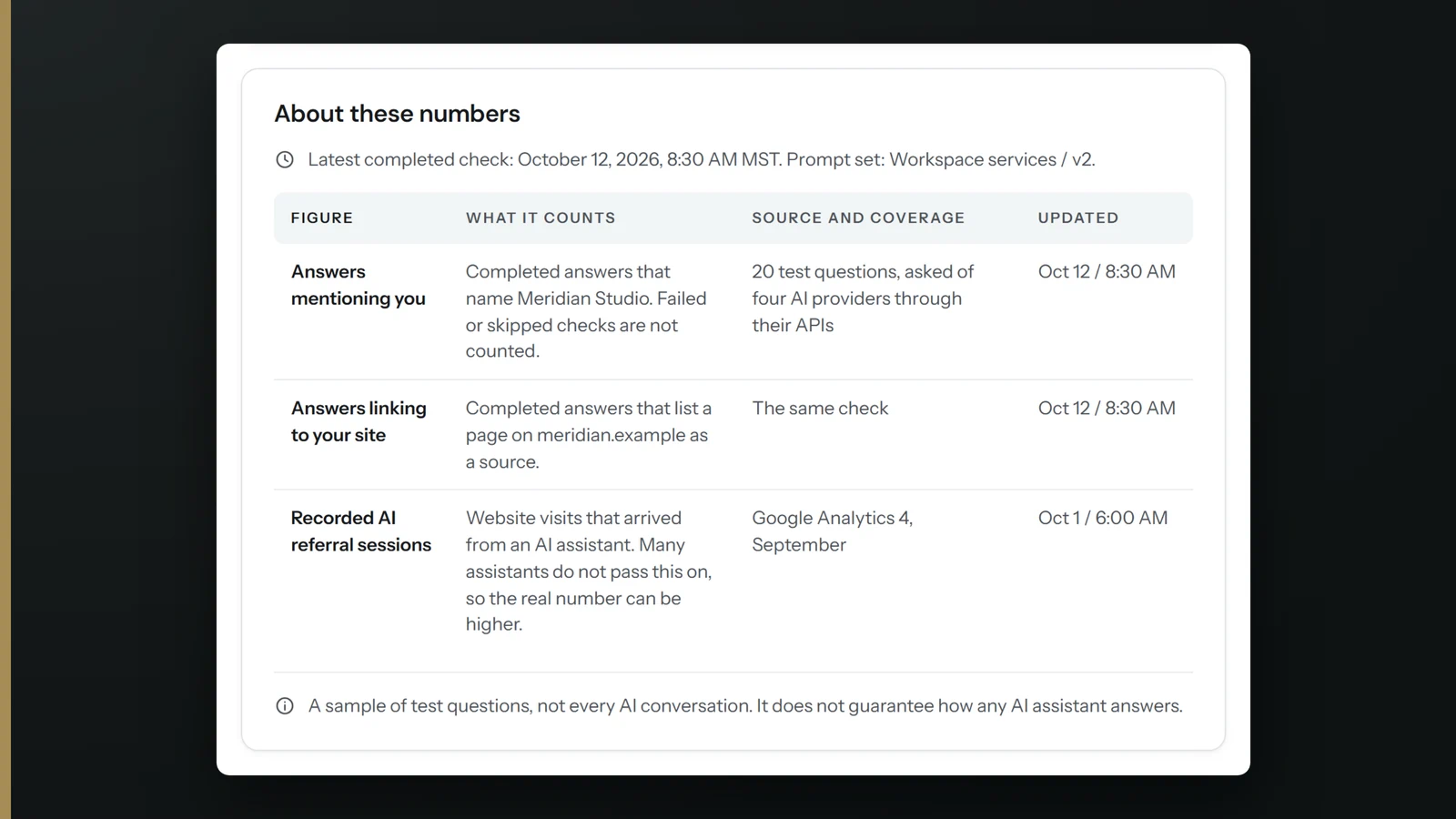
The same care applies to measuring. ScaleLounge's AI Visibility reporting, part of the Growth, Scale and Executive partnerships, samples a defined set of buyer questions through the providers' documented APIs and records what each answer contains. That isn't a recording of what any one person sees.
A few rules keep it honest:
- A visit from an AI tool means someone arrived from an AI tool, not that an AI recommended the business.
- Failed calls to a provider are left out, never counted as the business being absent.
- Until there are at least 20 valid observations, the page says "Building baseline" instead of showing a number that would mean nothing.
Where I start with a business
Before anything else, I want to see where the business already appears and what each place says. The free Online Presence scan does that: a scan of where the business already appears, with the public evidence behind each finding. It's included with the free ScaleLounge account.
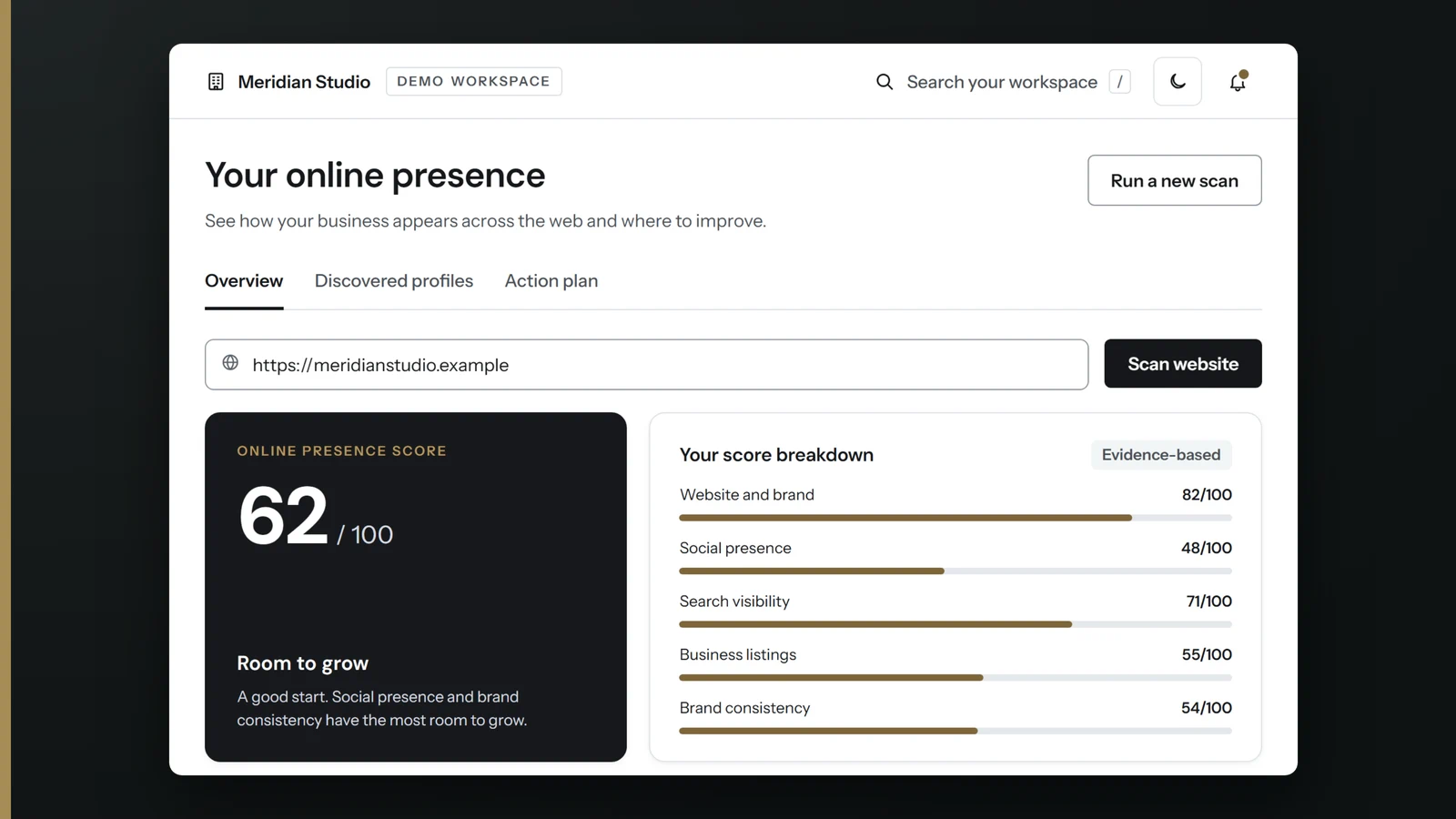
Reading the findings is quiet work. A name spelled two ways here, an older description there, a service that shows up on one site and not another. The public evidence means the conversation starts from what's actually out there, not from anyone's memory of it.
When the profiles need work, Brand Presence Setup starts from what the scan found. It puts one approved brand kit behind up to 8 social profiles, plus a Google Business Profile where the business is eligible, and nothing goes live until the owner approves the exact branding. It's included with the Growth, Scale and Executive plans.
None of that promises a mention in any AI answer. What it does is give the web something clear and consistent to say about the business when someone asks. That's the part I can work on, and the part I can show with evidence.
Rather hand this off than add it to your week? That is what ScaleLounge is for. See what ScaleLounge handles.
FAQ
Can anyone promise that AI will recommend my business?
No. Answers vary by tool and by session, and nobody controls them. What can be improved is the material they draw on: clear positioning, consistent business details and useful articles that answer real buyer questions.
Is a monitored AI answer the same as what my customers see?
No. Monitoring samples answers to a defined set of buyer questions through the providers' documented APIs. It's a useful read on what those answers contain, but it isn't a recording of what any person sees, which can vary by account, memory and session.
Is this different from regular marketing?
Mostly it's the same careful work: a plain statement of what the business does, the same details everywhere it's listed, pages that search engines and AI tools can reach and read, and articles that answer what buyers actually ask. The difference is the lens.
