
The small approval step that slows your publishing
 Katie LendelFounder & Strategic Marketing Lead
When publishing slips, most people look at the writing first. Was the idea slow? Was the design stuck? What I see more often is a finished piece sitting in a queue, waiting for one person to say yes. That person is usually the owner.
That's the odd thing about approval. It feels small. A minute of reading, a tap, done. So it's the first thing to slide when the day fills up. Nobody is against the post. It just isn't anyone's emergency.
The yes belongs to the owner, and I wouldn't change that. What I do look at is how the yes gets given. Three things make it lighter: approving in one sitting a week, sending notes instead of rewrites, and approving from a phone. Here is how each one works.
Why approval becomes the slowest step
Most steps in a marketing week run on their own clock. Drafting, scheduling and publishing happen whether or not anyone is in a meeting. Approval is different. It waits on a person who is also running appointments, orders, payroll and a team.
It also has no deadline of its own. A client call has a start time. A post waiting for review has nothing that says now. So it slides from Monday to Wednesday to next week, a little at a time, and every slide feels reasonable.
The cost shows up in two places. The first is timing. A post about Friday's event is worth less on Saturday. The second is rhythm. Publishing works because things appear when people expect them, and a piece still waiting on its yes leaves a gap in the calendar.
None of this is about willpower. The same busy week that makes someone a good operator makes a queue easy to leave for later.
ScaleLounge takes this work off an owner's plate, from the strategy to the work itself. See how ScaleLounge works.
What it looks like from my side of the table
These are patterns, not one client's story. They're what I notice when a piece is ready and the week still slips:
- Pieces approved all at once, then nothing for days.
- A rewritten version coming back in place of a note.
- A "looking at it tonight" that stretches into the weekend.
- One tricky piece holding up four easy ones.
- A queue that gets longer each week, with no one saying why.
The three changes below are gentle ones, and none of them is about working harder.
Approving in one sitting a week
The first change is the simplest. Instead of approving whenever something arrives, the owner reads everything together, on the same day each week.
A week's pile is smaller than it sounds. On Social Essentials, 8 original posts a month is about two posts a week. On Growth Partner, a typical month is 12 posts, 2 short-form videos, 4 YouTube videos and 4 SEO articles, which comes to five or so pieces a week. That fits in one sitting.
A standing sitting does a few useful things.
Fewer decisions about when
"Do I have time for this right now" gets answered once, on the calendar, instead of every time a notification lands.
Better reading
Pieces read back to back show things a single piece hides. Two posts that open the same way. A tone that drifts toward salesy by Thursday. A detail that shows up twice.
Room for a note to come back
If the sitting falls a day or two before the week's first post, a piece that goes back with a change still has time to return before it publishes.
How a sitting can run
It's the rhythm I've set for ScaleLounge's own calendar: one sitting, the same day each week. Inside the sitting, the order is simple. The owner reads in the order the pieces will publish, so the week makes sense as a story. What's right gets approved as they go. What isn't goes back with a note of a sentence or two. The sitting ends when the queue is empty, and anything new waits for next week.
Notes instead of rewrites
The next thing I see slowing a week down is the rewrite. A caption is a little off, and the fastest route feels like fixing it personally. So the owner rewrites it that night.
That spends the owner's time, which is exactly what the arrangement was meant to protect. It also fixes one piece and teaches nothing. The next caption arrives with the same problem.
A note does the other job. It carries the reason, and the reason is what the next piece starts from. Sample notes can be this short:
- "Too formal. This isn't how I talk to clients."
- "Right topic, wrong angle for this week."
- "We say guests, not customers."
- "That price changed."
A note about a word or a tone applies to every piece that comes after it. A rewrite only repairs the one piece in front of the owner.
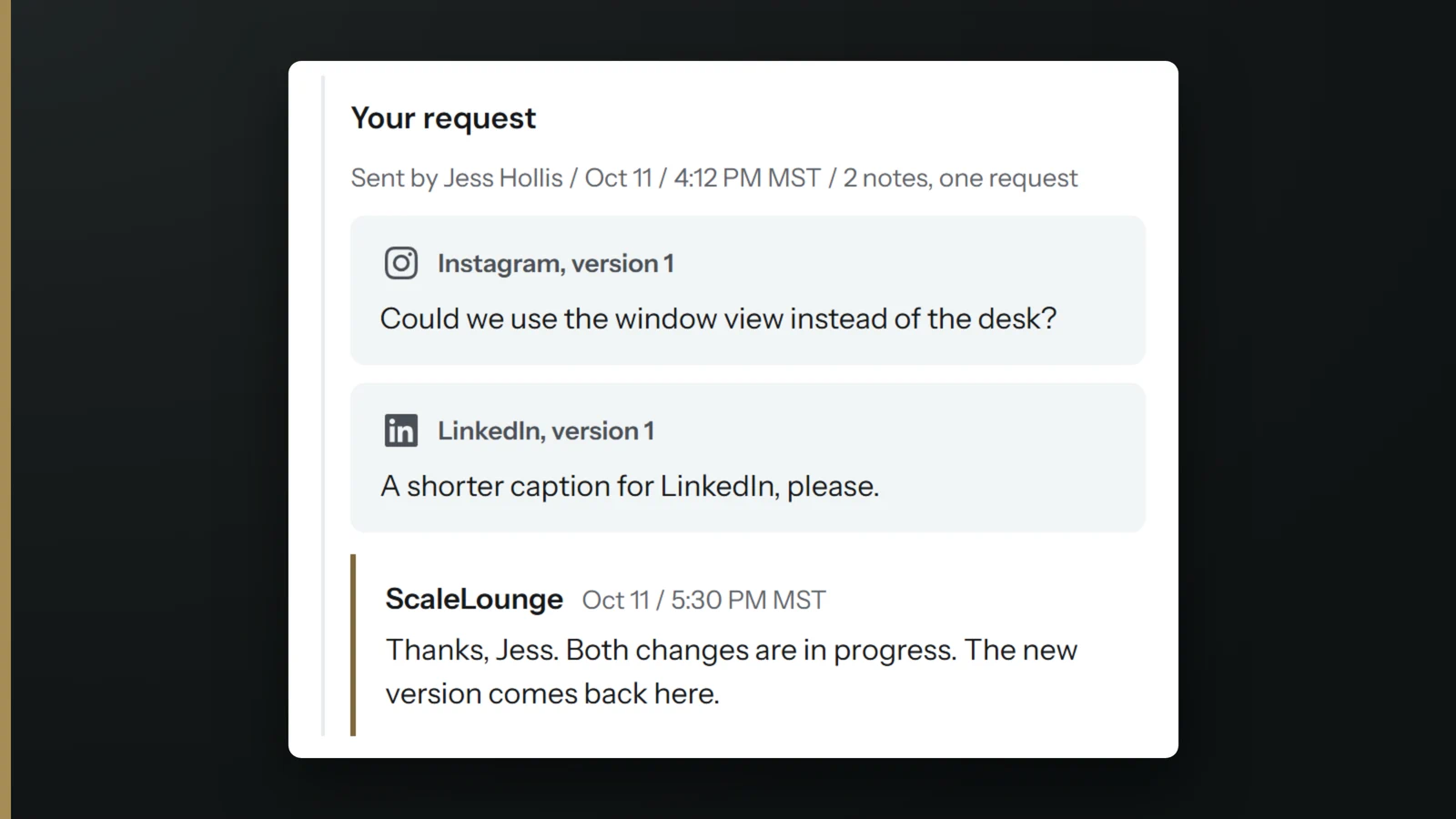
There's one case where I'd rather have the owner's own words: a story only the owner lived, or a fact only the owner knows. That's context, and the context is the owner's to give. Everything else can go back as a note.
Approving from a phone
Owners review in the gaps. Between appointments, at the counter, waiting on a delivery. A review step that needs a desk waits for the desk, and the desk is often the one place the owner isn't.
In the ScaleLounge workspace, reviewing works from a laptop or a phone, in one place. The choices are the same either way: approve the piece or send it back with a note. Once a piece is approved, ScaleLounge handles the publishing.
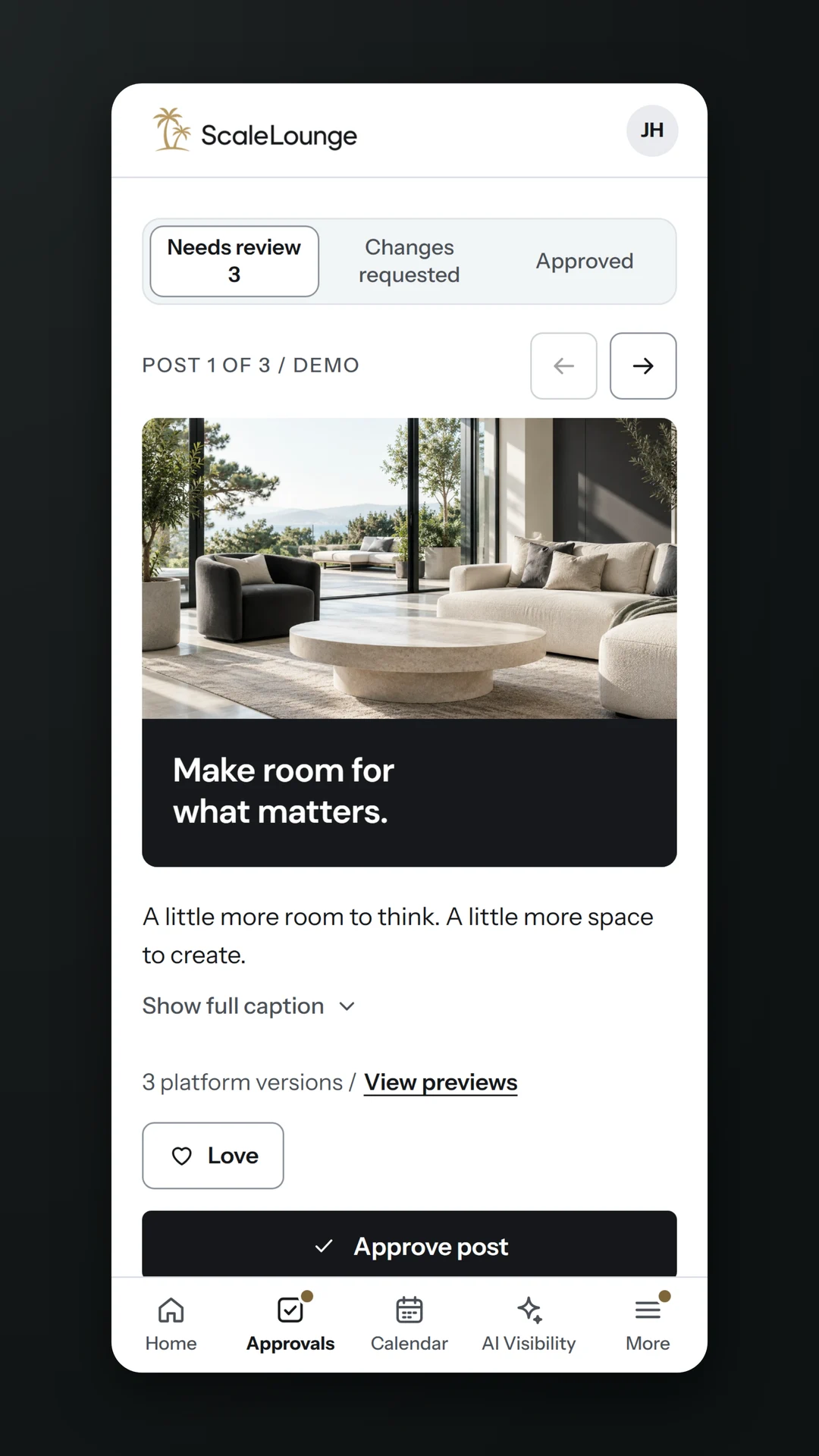
A phone and a weekly sitting go well together. The sitting doesn't have to happen at a desk. It can be a quiet stretch on a Tuesday afternoon, phone in hand.
What I'd still save for a bigger screen is a long article. Short posts read well on a phone. A 1,200-word article is easier to judge with room to scroll.
When slow approval is a signal
Sometimes the approval step isn't the problem. It's the messenger.
- The same note keeps coming back. Then the brief or the brand voice needs another look, and that's on the partner as much as the owner.
- The queue is long and nobody opens it. Then the volume may be more than the business can use. Fewer, better pieces is a fine answer.
- Every piece gets rechecked from scratch. Then it's a trust question. Trust grows from seeing the work, so the early weeks matter most.
I'd rather hear any of these early than watch a calendar drift.
A light approval step shouldn't mean a loose one. Nothing publishes before the owner's yes, and a quick sitting is still a real reading. It's the same yes, given in less time. That's the idea I built ScaleLounge around, and the free ScaleLounge account works the same way: the content writer drafts in your brand voice, you can edit anything before you use it, and nothing goes out without your approval.
Rather hand this off than add it to your week? That is what ScaleLounge is for. See what ScaleLounge handles.
FAQ
How often should a business owner approve marketing content?
Once a week is the rhythm I'd pick for most small business calendars. A week's pieces fit in one sitting, and a piece sent back with a note still has time to return before it publishes.
What should I say when I send a piece back?
A sentence that names what felt off does the most: the tone, a wrong detail, or the wrong focus for the week. A note carries the reason, so the next piece starts closer to right.
Can I approve marketing posts from my phone?
In the ScaleLounge workspace, yes. Reviewing works from a laptop or a phone, with the same two choices either way: approve the piece or send it back with a note. Nothing is published before the owner's yes.
